"Motivational Music Radio", music business advice, information, tips and cases studies created specifically for you, the independent Artist and/or label owner. (By the way, producers, songwriters, managers, musicians, rappers and all others are also welcome :) Founded by Ty Cohen and Jawar (I'll brag about their credentials last) The "Motivational Music Radio" Show will provide you with real life, practical information that you can, erh um, excuse me that you WILL use to become far more successful at marketing, promoting and selling your music on a global scale... This show is NOT about the traditional, warmed-over, cliche-ridden advise that you will typically find replicated at and on a million other "Music Industry Advice" sites, shows, seminars and workshops. On a regular basis you'll learn "Systems" that you can use to create a loyal following of fans, bring in consistent sales and a steady flow of income (In other words, you'll learn what most independent artist will NEVER learn!)
Motivational Music Radio

Saturday, February 14, 2009
Motivational Music Radio Hosted by Ty Cohen & JaWar
 more
more

How does the music industry compare to internet marketing?
Musicians have to learn to become Internet Marketers to get there music to the masses. Here is a good video that explains what it takes to take their music career to the next level.
Thursday, February 12, 2009
Mike Jones signs Endorsement Deal with House of Dobbe Cognac
I found this article about Mike Jones

Mike Jones signs Endorsement Deal with House of Dobbe Cognac
Mike Jones
 is, in fact, currently on our premier promotional engagement at Club Asia, at Planet Hollywood in Las Vegas Las Vegas (läs vā`gəs), city (1990 pop. 258,295), seat of Clark co., S Nev.; inc. 1911. It is the largest city in Nevada and the center of one of the fastest-growing urban areas in the United States. . This joint promotion, with Club Asia and Planet Hollywood, started on the 1st of December 2008, and ends on the 19th with a grand Dobbe' Model Talent event. Dobbe' Cognac will collaborate with Mike Jones during the Super Bowl for a special promotional event to promote the line of cognacs and his new record.
Joel Stohlman, CEO (1) (Chief Executive Officer) The highest individual in command of an organization. Typically the president of the company, the CEO reports to the Chairman of the Board. , stated "We are excited that this particular product, the line of Dobbe' cognac is a perfect fit for Mike Jones
. He is a terrific self promoter and will do whatever is required to make this product launch a success. We will give him the support he needs throughout the U.S., and continue marketing and promoting the products in conjunction with the record launch."Mike Jones
stated, "This opportunity could not have come at a better time, with the launch of my new single. I am fortunate enough to have the opportunity to do what I love; produce hot music and engage in business opportunities. The story of this product fits my life. I had to work extremely hard to be a success in the music industry, and will give the same level of commitment to House of Dobbe'."About Mike Jones www.whomikeJones.com
Mike Jones
is a internationally known rap artist that sold over 1.5 million units under the Warner Bros.An American ideal of a happy and successful life to which all may aspire: is his sophomore album and Mike Jones
returns to tell the story of his extraordinary triumphs with the aptly titled sophomore album, The American Dream. Mike Jonesis also the proprietor of the popular Ice Age nightclub in Houston, which is frequented by Eva Pigford, Morris Chestnut, Vivica Fox, Meagan Good, Tracy McGrady, Vida Guerra, and other celebrities.
Wednesday, February 11, 2009
Michael Laskow, the president of Taxi.com - On the Internet for Indie Musicians
Predicting the future is never easy, but trying to anticipate what it will bring can help a lot as long as you really know the subject that you're speculating about. So when I was looking for somebody to forecast which opportunities and challenges independent musicians will face in the next five or ten years, I turned to Michael Laskow (see Fig. 1). As the founder, president, and CEO of Taxi (www.taxi.com) — an organization that helps unsigned bands, artists, composers, and songwriters get label deals and find placement for their songs and compositions — Laskow is particularly attuned to the circumstances that recording musicians encounter.
Initially a recording engineer, Laskow has worked with artists such as Eric Clapton, Neil Young, and Crosby, Stills, Nash, and Young, to name just a few. In his years working at Taxi, he has dealt frequently with record labels, music publishers, music supervisors, and production music libraries, as well as with other similar entities. In short, he has been living and breathing the music business for the past 32 years.
Where do you see the music business going in the next five to ten years?
Things are going to change. The major labels simply won't be able to operate the way they do now. However, the whole music-revolution thing isn't what it appears to be. Musicians are so used to hating major record labels, and it's easy for them to think, “Screw the major labels; I'm going to do the independent thing.” But truthfully speaking, most musicians don't really hunker down and do the hard work and the heavy lifting, so they stay right where they are. They might build a page on MySpace, but they'll be one of millions. They'll probably put their money into recording a CD, have it pressed, and make it available for sale online — all of which are good ideas. But then they stop right there, so that in the end, all those independent-music revolutionaries don't end up any better off than before their CD was produced. They are somewhat invisible today, and most of them will be relatively invisible tomorrow.
How do you see things changing? Do you think that technology will alter the delivery system for music?
The delivery system has already been changed. Downloading and streaming are certainly easy enough to do. In a perfect world, people could go to a Web page one time and fill out a survey, answering items such as “These are acts that I like,” “These are acts that I've liked in the past,” and “These are genres that I listen to.” They could subscribe to services that filter the music for them and deliver it to them in the order that they want. So they would be able to get whatever they want, wherever they are, whether it's tethered to a wire or untethered via satellite.
Into a portable unit of some sort?
Yeah. I think that someday in the not-too-distant future, you will be able to access your own personal jukebox of music that will reside somewhere else on a hard drive, so that you don't have to schlep a device with you. Why should you have to carry an iPod or a cell phone that has a hard drive with you? Why can't you just have your music and be able to access it wherever you are? Let's say that all the music is stored on a central hard drive; if I go to your house for a party, I could punch in my PIN code and pull up “Laskow's disco party mix” on your home stereo. Or if we're doing a road trip together, I could pull up my list in your car.
Do you think that the interaction of video and music will become more important as Internet video delivery becomes even faster?
That will be determined by demographics. It will be very important for the 13- to 24-year-olds; we're seeing strong evidence of that fact demonstrated on YouTube. Kids don't necessarily want to watch some $300,000 video made by a major label. Now they think it would be much cooler to shoot their own video, whack it together in iMovie, and throw some band's song underneath it.
How do you foresee that musicians will be marketing themselves and their music in five or ten years?
The key word is marketing. It used to be that you could just create great music, and maybe an A&R guy would find you because you were talented. But now, there's so much clutter out there. I came to a realization reading in bed two weeks ago: I was reading The Long Tail by Chris Anderson [Hyperion Books, 2006], which is an excellent book. My realization was that the type of people who got the attention of record companies in the past year or five years ago, built a following, got signed, and maybe even had a big success will probably be the same ones who will succeed in the future — because they work hard at it.
So even though technology is changing, only a tiny percentage (like about one-tenth of 1 percent) will ever have what I call a huge success — that is, one that puts hundreds of thousands or millions of dollars in their pocket. What I'm hoping will come about as a result of the Internet and other delivery systems, though, is the creation of a musician “middle class.”
Can you expand on that concept?
The advent and continuous growth of high-quality, inexpensive recording gear for the home-based recording musician and engineer has created an abundance of good music that works for all kinds of things, not just hit records. Film and TV placements are the most obvious. You don't need to go to a $300-per-hour, 48-track digital studio with a 15-foot-long SSL sitting in the room to record great-sounding tracks that are just fine for film and TV.
So musicians who have a knack for composition, some recording gear, and decent engineering chops could be part of that musician middle class?
I think that we're 60 percent of the way there already. You can take somebody with a decent little home studio and reasonably good skills using that studio, and they can earn $150,000 a year creating music for film and television. It's absolutely possible. I know because I've seen it with my own eyes. I'm not talking about a scenario where you get a song placed in a movie and make $50,000 — that's not likely to happen. But it's definitely possible to work diligently and get dozens of songs placed each year in production music libraries. And over a five- to ten-year period, those songs multiply to become hundreds of songs in several different libraries, and this thing just snowballs over time.
How would you recommend that musicians prepare themselves in order to adapt to the changing musical landscape?
Technology has dramatically improved a musician's ability to create and distribute music. But technology hasn't changed a musician's ability to market their music. So if I were a musician, I would sit down and decide what my goal is: Do I want to be a rock 'n' roll star and fly around on a private jet and have a briefcase filled with millions? Or do I want to be able to make my own music, do what I love to do, and earn my living that way? Once you determine what your goal is, then make a list of steps. Most musicians are creative people and tend to skip those businesslike functions.
Figuring out a career path isn't that hard. What is hard is making yourself do the hard work and the heavy lifting. Don't rely on the technology to do the work for you. Yes, it can help you make better music. Yes, it can help you get that music out to more people. But you have to know how to do the marketing.


Tuesday, February 10, 2009
Tim Sweeney’s Guide To Releasing Independent Records
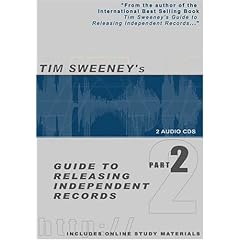
Tim Sweeney’s Guide To Releasing Independent Records Part 2
Welcome to the follow up of Tim Sweeney’s International Best Selling Book, Tim Sweeney’s Guide To Releasing Independent Records. Now in this new audio book, Tim will teach you specific strategies he has personally used and developed to help thousands of artists gain the real media and internet exposure they want for their music and most importantly the sales they want!
Tim will teach you the following that will help you sell your first 10,000 CDs in your home market and state!
* He presents in detail the strategies of why you need to build your career at home and why it is a critical mistake to promote your music on a national basis too early in your career.
* How to avoid the early trouble spots that can damage your career.
* The importance of getting rid of your press kit for an Artist Profile and how that will help you get more shows, write ups in the press and radio airplay.
* How to find new fans to come to your shows through effective street promotion you can do yourself.
* The secrets to having a web site that can actually sell CDs versus one that just sits there.
* Is a distribution really what you need at this point or a distribution network of stores that will buy directly from you?
Then Tim will teach you specific strategies he uses to more effectively use the press and television to get more attention for the artists he works with. Even how to capture the attention of fans of commercial radio stations without even mailing the station a CD to consider playing.
Tim Sweeney’s Guide To Releasing Independent Records Part 2 is the ultimate guide for any artist who wants to quit their day job and support themselves full time with their music. By following the information in this audio book and accomplishing the goals laid out in it, you will be meeting the criteria that major and key independent record companies look for when considering signing a new artist as a "priority."
** This audio book has a corresponding web site that will provide you with the notes on each section of this audio book!

How to Promote Your Music on Myspace

Myspace.com is one of the most popular social networking sites. People of all ages have active myspace pages. It has also become a good medium for small business owners to network with people from all over the world. Promoting yourself or your business on myspace is a great way to enhance your marketing and public relations strategy.
*Step 1:
Create your myspace profile. Make sure to keep it as clean and professional as possible. Too many pictures, music or video can be distracting and make your page load slowly. Make your page expressive but easy to read.
*Step 2:
Build your friends list. The easiest way is to start with friends and family. Lots of people have myspace pages so it should be easy to find others you know. Send them a friend request and once they add you to their friend lists, go through their pages and add any mutual friends that they may have.
*Step 3:
Post comments on people’s pages. A great way to indirectly build your friends list and promote your business is by posting comments on other people’s pages.
*Step 4:
Send out bulletins. As your friends list grows, you can continue following the above steps, but you can also send out bulletins promoting yourself or your business.
*Step 5:
Start writing in your blog. Write a few interesting blogs and then start sending out invites and bulletins for people to check out and join your blog.
*Step 6:
Include your myspace page in your email signature. Whenever you send out an email, you will be promoting your myspace page and building your friends list.


To Be Successful In Music Marketing On Any Level Is To Define Your Musical Niche
Opposite from my Artist Image video, if you are looking to infiltrate the power pop music market you need to define your musical niche.
Here I talk about once you have chosen the style of music you want to pursue then you have to look into that marketing and form your plan of attack.
Not to say that if it is indie Rock that you performing that you can't use many different styles of arranging but the under lying style is still present. Successful music marketing works around a niche.
So in essence, you don't present yourself as a Hip Hop artists and decide that because you wrote a cool Country sounding track that you should drop that in there. Be CONSISTENT!
If you mix up your style you risk loosing fans not to say getting new ones that don't understand what you're putting out there.
Great case in point is the band Extreme (dating myself). They were a great rock band but there first release as "More Than Words" which was an acoustic song.
Many people returned that CD because the thought that Extreme was an act that was acoustic driven. Actually, I would have blamed the label for that fuck up!
Buy Andy McKee's Music
Music Promotions - The Band Performance - Try Using The CD Flier Along With Posting
This is wonderful advice here. I can remember when I was telling my crew about this idea and they just blew it off like it meant nothing. So to see someone else with the same idea is very refreshing. Watch the video and you can read his original comments right below the video. Implement this into your plan for sure!
I don't want to give away too much of this in text but this video is about taking the the typical live band promotional flier and giving people a taste.
For about the same cost as banging fliers around town (including gas) you can get double your bang and a stronger return with this particular type of flier.
This also cuts down on the clutter that many cities are coming down on and actually fining bands, artist and venues for posting bills/fliers about upcoming performances.
It's called the CD flier. This story is one from the bowels of Hollywood rock scene. they tried it and it worked big time.
Here are a few tips on the CD flier.
View From the Top: Interview with Disc Makers' President, Tony van Veen
Disc Makers president Tony van Veen touches on downloads, major labels, and the life expectancy of CDs.
How do you think the advent of digital downloads and new technologies will affect the CD market in the short and long term? Especially for indie artists?
There’s been a clear impact, for major label and independent artists – though in my opinion the impact on each has been quite different. Major artists rely on name recognition to sell units. Name recognition is their biggest strength, but with regard to downloads – the illegal kind – it’s also their Achilles heel. Clearly, music fans go online in massive numbers to find free content to download, and that cuts into major artists’ profits by reducing CD and paid download sales. On the flip side, for independent artists, downloads are a great tool. Independents don’t have name recognition yet, and can use the internet – and downloads in particular – as a tool to become more widely known. By offering free downloads off their own site, or even by seeding Peer to Peer networks with free tracks for others to find, downloads are actually a way to increase name recognition. And of course, selling downloads on sites like iTunes, Napster, and DigStation.com provides a revenue opportunity.
So how long will CDs be around?
For a long time. Overall CD sales are declining slightly, but the ones taking the hit are the major labels. Independent CDs are still growing. Think about it. As difficult as it is for independent artists to get radio play, distribution, and promotion, their main opportunity to make money from their music is by performing live and selling product – both CDs and merch – at their performances. You can’t sell a download at a gig. That takes CDs. I foresee independent CD sales to keep growing for many years to come – with the simultaneous growth of download sales.
What do you consider the most exciting developments/opportunities for independent musicians?
How technological advances have opened doors for artists and given them access to resources they never would have had even 10 years ago.
It starts with recording, and some of the great tools available on the desktop today for quality recording, mixing, and mastering. Programs like ProTools, Cakewalk, and even Apple’s Garageband are examples of this democratization of recording.
As that’s happening, professional recording studios and producers are now actively wooing independents at rates they can afford, so great quality recordings are definitely in the artist’s reach. Furthermore, technology has broadened artists’ opportunities for performing and promoting themselves, as well as generating revenue through publishing, and licensing for film soundtracks, TV, and video games. Sonicbids and Taxi are two prominent companies that empower artists in those areas, and there are others out there.
And while physical distribution through bricks and mortar music stores is still very difficult to secure, online distribution and sales through sites like CD Baby have made it possible for artists to sell product worldwide. And download sales through major sites like iTunes and DigStation continue to enhance artists’ sales channels.

If you were back in college today, trying to make it with your band, what would you do differently?
I’d pay a lot more attention to the business side of being an artist. When I was performing, all I was interested in was writing songs, rehearsing, recording, and performing. The business side – booking, promoting, getting radio play, etc. – was a distant second to the artistic side. Yet, it’s a huge factor in an artist’s success. We looked at music as a fun diversion, not a job. That led us to doing the fun parts, and not the hard parts. This has nothing to do with technology. It’s as much true today as it was when I was performing in the ‘80s.
Would you try for a major label deal?
Ah, the elusive major label deal. So many artists aspire to it as a way to easy riches. But the odds of success are extremely small. When we performed, we never focused on getting a deal. We were a hardcore band anyway, so getting a deal kind of went against our whole reason to be.
In this day and age, my recommendation to artists is to do as much of it yourself, for as long as you can. Build your fan base, build your buzz, tour the country in a van, and build up the number of CDs you sell. Once you have a track record of selling thousands of CDs, you can negotiate better terms if you have the opportunity to sign with a label – major or indie. Major labels present an opportunity for artists with a track record: they provide access to promotion and distribution resources that you just can’t get on your own.
Of course, we have many customers who don’t aspire to a label deal. And many don’t even perform live – they’re songwriters looking to sell some CDs and maybe get a publishing deal. That’s a different music career, and one that can be lucrative as well.
The internet has already dramatically influenced the entire music business in so many ways. As the new breed of music fan is increasingly internet savvy, how do you see that impacting how indie bands market, sell, and interact with their fan base?
The internet is such a great communication tool. It’s cheap, even free, to set up your own web site, and get onto other sites like MySpace that get you in front of thousands or tens of thousands of potential fans. It makes it super easy for fans to let others know about you, and folks coming to your site get to see and hear you. This wasn’t possible 10 years ago.
The tools online that enable artists to manage their mailing lists and send email are incredible. Between email and blogs, artists can now communicate regularly with their fan base at virtually no cost. An artist’s challenge is to get fans to know they exist. The internet can help with that. But even more so, artists need to remind fans who know them that they’re still around, that they’re performing, that they have a new recording out. The internet is an incredible tool for those kinds of communications.
What drew you to Disc Makers in the first place? It was a much different company back then.
It was. When I started here in 1987, Disc Makers was a small regional company pressing vinyl and duplicating cassettes. I was a drummer in a band, and wanted to work in the record industry. I had to support myself, so I couldn’t afford to do an unpaid internship at a label, studio, or radio station. Disc Makers allowed me to get into the record business and pay rent.
It was a great fit, because the company president, Morris Ballen, had just decided to start focusing on independent artists. I was the customer he was focusing on, so I was able to bring my understanding the indie music scene to Disc Makers. And with my business education on top of that, I was able to contribute and help to grow the business.
Looking forward as the president of Disc Makers, what do you see as the most exciting new possibility and area for growth?
There are several. Optical discs continue to grow at double-digit rates. And as we continue to grow and develop our in-house services and processes, we should be able to continue to improve our delivery times, which are already the fastest in the industry. Most packages are now done in just 10 business days – start to finish. We’re looking to improve that. That will make our services more attractive to artists, who are always in a hurry to get their product out on the street quickly.
The second opportunity is to continue to deliver orders in smaller quantities. Our online Short Run Self Service program allows artists to order as few as 100, 50, 10, or even just one CD or DVD. This has been an area that has grown very strongly in recent years.
We’re excited about our offering digital downloads with DigStation.com, which gives artists a free page that sells their downloads for just 99¢ – 70¢ of which goes right to the artist. We’ve also been successful with the launch of our custom Merch program, which offers artists an easy, affordable way to get custom-printed shirts, hats, and more to sell at their gigs.
What do you see as your biggest challenge?
As we continue to get bigger – both as a player in the marketplace and literally in terms of the growing number of employees – keeping Disc Makers in touch with our indie roots is going to require an active effort. When CDs first hit the market, we were in a different building with maybe a tenth of the staff we currently have. Now we’ve got a number of outside sales offices, a full replication plant, and almost 500 employees.
Of course, this growth has served our clients and has enabled us to do all the things we do today. But with this growth has come the inevitable need for us to grow up, as a company, and new policies and procedures have replaced some of the looser ways of the old days. It’s part of our getting better, but I recognize we can’t let that undo the fabric of who we are. We have to cultivate and nurture the indie music roots that define us.
Not that it should be such a difficult a task. Just take one walk through our building and you can see we’re flush with independent musicians, artists, and thinkers. Our holiday party, DMPalooza, consists of 25 bands made up of Disc Makers employees playing the night away. We’ve managed to stay true to ourselves through growth and change, and our job will be in continuing to deliver great value, quality products, and friendly service to our clients.
In January 2007, Tony van Veen took the reigns as President of Disc Makers, having served as Vice President of Sales and Marketing for nearly a decade. He joined Disc Makers in 1987 as a marketing associate and project manager upon graduating from the University of Pennsylvania’s Wharton School. Tony played drums, recorded, toured, and released a few projects on vinyl and cassette with several underground rock bands while in college, and also ran a successful small independent record label for four years.


About Me

Join These Communities
 |  |
 |  |
 |  |
 |  |
 |
 |
 |
 |
 |
 |
 |
 |
MEDU NETR

Erge Entertainment

Copyright © 2009 Fresh Themes Gallery | NdyTeeN. All Rights Reserved. Powered by Blogger and Distributed by Blogtemplate4u .