YouAreCreators is Back... Lets share knowledge!: Learning the Laws of Abundance!: The Law of Abundance is the principle that there is more than enough for you to have everything you want out of life. According to the La...

Thursday, January 9, 2014
YouAreCreators is Back... Lets share knowledge!: Learning the Laws of Abundance!
 more
more

Wednesday, February 24, 2010
The Introduction

What is up world? I have been thinking about starting this blog for a long time now. I have been through a lot of stuff in the past 2 years. Everything from feeling like I am on top of the world all the down to sleeping under bridges.
Thursday, March 19, 2009
Musicians and The Internet - Making Mistakes Online
By Heather McDonald, About.com
Bio
Blog
Forum
Ah, the internet. There's no denying it has turned the music industry upside down. File sharing and the increased popularity of MP3s have both left labels scrambling to update their business models, and musicians have discovered that they suddenly have a lot of tools at their fingertips to take advantage of their own careers. Sure, that's a good thing for musicians - when it's managed properly. The downside of the musician's life online is that the internet is a minefield of scams and opportunities to make some really bad decisions. Here's a rundown of the top mistakes musicians make on the internet
Musicians' Top Mistakes Online
Can MySpace, Twitter, blogging, etc, be very important for your music career? Sure they can. But way too many musicians and music related businesses let these social networking tools become their jobs instead of the music. If you're devoting hours a day to making MySpace friend requests or adding people on Twitter, you're going about this all wrong and have gotten off track a little bit.
The bottom line is that you're not going to win many new fans by being their virtual friend. You're going to win new fans by writing some good music. Social networking is a promotional tool that you can use to let people know about the things you're working on to keep them interested and engaged, and an important part of managing it well is exercising some restraint when it comes to how much time you spend on it versus other things you need to do for your music career.
If you're still unsure, take a good listen to some of the musicians on social networking sites that have tens of thousands of friends/followers - you'll see pretty quickly there's no real correlation between number of friends and musical prowess. Remember why you're online in the first place - to promote your music. Make your offline work the priority.
Paying People To Do What You Could Do For Free
Someday, when you're selling millions of records, you'll be able to pay someone to tie your shoes, pour your coffee, carry your water bottle and any other activity you find downright objectionable. When you're trying to get your music career off the ground, however, you have to spend your money wisely. You can find plenty of people on the internet who are making a tidy little living selling musicians information they could easily find themselves for free if only they devoted an afternoon to the Google. Don't encourage these people (who I find downright objectionable) by using their services. You have better things to spend your money on. A turkey sandwich would be a better investment for your music career than paying someone to copy a label's address off their website and send it to you.
Learn More About Building Your Own Contact Databases:
Build a Press Database
Make a New Music Industry Contact
Musicians' Top Mistakes Online
The internet gives a platform to, well, anyone with an internet connection. When it comes to the music industry, there are A LOT of people weighing in on the discussion. That means you have to become a smart consumer. You're bound to encounter conflicting advice about your music career online. That's not intrinsically a bad thing - there's no one way to do something, and even people with plenty of music business experience disagree on the best approach to getting the job done. Further, different websites are geared towards different audiences, so the advice is different. You can use this disparity in advice to your advantage. Take it all in, weigh it all up, take a little from column A, a little from column B and come up with your own best plan.
That's the good side of the democracy of music industry advice on the internet. There are a few downsides. Here are just a few things to watch out for:
*The All Business, No Music Approch: Sometimes, people with a business background, but no MUSIC business background offer advice on the industry. Musicians can almost always benefit from listening to words of wisdom from someone with some business management know-how, but many people who have not worked in a creative industry don't appreciate the differences between the arts and "regular" businesses. As a musician, you ignore these differences at your peril.
*The Philosophical Approach: Brainstorming strategies is one thing, but don't get so wrapped up in convoluted conversations packed with business buzz words that you don't actually do anything. It's easy to run down this road, but look for solid, clear, actionable advice and try not to get distracted by lofty musings. It's fun to puzzle over aspects of the music industry, but just make sure you strike a balance between staying part of the conversation and accomplishing something concrete.
Paying for Questionable Advice
Even worse than getting bogged down in questionable advice is paying for it. There are A LOT of people out there who have enough understanding of the music industry to recognize that there is a knowledge gap and to know that there are many people who would pay just about any price for a shot at making their music business dreams come true. And so, they charge you an arm and leg (in some cases, two legs) to give you vaguely inspirational, business buzz word filled advice that either has little real world MUSIC BUSINESS application or is just plain wrong.
Please, please, PLEASE don't pay people hundreds and hundreds of dollars to tell you things you probably already know yourself. There are plenty of places online where you can get good, free advice. If you want some real insight into making it in the music industry, check out some interviews with people who have gone down the same road that you're on. Soak up their stories and learn from their successes and failures. It's free, and it's worth way more than most of the advice these people who charge you tons of money to tell you to set up a MySpace page can give you.
Now, I'm not saying here that people shouldn't be compensated for working for you, and if someone comes on board and helps you out with your career, then sure, they should be paid. How can you tell the difference between legitimate opportunities and people who are trying to sell you common sense? The less than legitimate people will tell you that anyone who disagrees with them doesn't know what they're talking about and that anyone who doesn't sign up for their program lacks vision or isn't really committed to making in music. Come on now, you know better than that. The music biz is risky, and a lot of people lose money in it. That's a fact. Just don't lose it to these people.
Not Considering The Source
If you were buying a car and the salesperson proclaimed to you that the future of automotives rests with the car they happen to be selling, you'd take that with a grain of salt, wouldn't you? Well, if there's one thing the internet is not short of it is proclamations about the future of the music industry. Many of the most forceful ones are made by people with a vested financial interest in seeing the future turn out just the way they're saying.
Back to the notion of being a smart consumer online: consider where you're getting your information. If you read a blog that argues passionately that music platform X is the wave of the future, that happens to have been penned by the owner of music platform X, you have a little more research to do before you make up your own mind.

Thursday, March 5, 2009
Twitter Power
It seems everyone is constantly raving about all the social sites and just how vital to your business they are. Instead of jumping on the bandwagon, I’ve been running tests on them…and I have to say the majority are greatly over hyped in value.
Some of them are very good resources for contacting potential JV partners or generating a few incoming links (we want those links for the search engines). The majority simply generate unqualified traffic that doesn’t convert and doesn’t buy.
There have been a few exceptions.
One of these is Twitter. In my tests on Twitter I noticed a profit pretty quickly. While most of the time you point to good valuable resources and content, you can tweet about some of your offers. And these tweets have converted into sales.
So the one social site I recommend to everyone now is Twitter.
I don’t have any materials about it yet as I’m still in the learning process. I’ve seen quite a few materials come out on Twitter, but none of them have been good enough to recommend until now.
This past week I received my copy of “Twitter Power: How to Dominate Your Market One Tweet at a Time!” by Joel Comm.
It’s excellent!
While many books in the internet marketing field are self published, Joel’s new book is published by John Wiley Publishing, a major business book publisher. And it shows in the presentation from beginning to end (although I did notice some typos so far).
Instead of trying to go into detail about each element of the book, here is a list of the chapter titles to show you how every major element is considered and covered from a beginner’s point of view:
An Introduction to the Social Media Landscape
What is Twitter and Why Is It So Powerful
Getting Started the Right Way on Twitter
Building a Following on Twitter
The Art of the Tweet
The Magic of Connecting With Customers on Twitter
Leveraging Twitter for Team Communication
Using Twitter to Help Build Your Brand
Leveraging the Power of Twitter to Drive Behavior in Your Followers
Beyond Twitter.com: Third Party Tools You Will Want to Know
Building Powerful Solutions on Top of the Twitter Platform
Play Nice: Legal Considerations
Putting It All Together: A 30 Day Plan for Dominating Twitter
Power Twitterers
As of right now, I haven’t finished the book yet (it’s 245 pages including the full index at the back). I’m looking forward to getting all the way through it soon.
If you want to grab your copy, pick it up from Amazon:
http://www.amazon.com/Twitter-Power-Dominate-Market-Tweet/dp/0470458429/
Right now Joel is also providing a 4 Week Online Social Media Bootcamp as a bonus which you can register for here:
http://twitterpower.com/workshop/
Neither of those are affiliate links. If you’ve ever considered using any type of social media…I’d recommend Twitter first.
Joel’s book is the best resource I’ve seen on Twitter so far.
When I checked the price on Amazon, it was listed at $16.47 so you can’t beat that price.
If you’re not using Twitter, you’re leaving money on the table. It’s as simple as that.
If you’re experienced with Twitter, you may want to only skim over the first couple of chapters to get into the meat later on in the book as Joel does start from a raw beginner’s viewpoint. 


Trackur - Social Media Monitoring Tools
Today I’ve been checking out Andy Beal’s latest venture - Trackur.
Trackur is an online reputation monitoring tool that has been developed for companies and individuals wanting to take a serious look at what is being said about them in the blogosphere. I can also see the possibilities for using this tool for higher end bloggers who want to track what’s being written about them and/or their niche topic.
The best way to get a handle on Trackur and what it does is to signup for the free 14 day trial. The second best way to understand it is to watch Andy Demo Trackur in the following video.
There are of course free tools that you to monitor the blogosphere (including Google’s News Alerts and Technorati’s Watch Lists) but Trackur is a much more integrated package that is sure to appeal to a higher end user. You can see how it compares to Google News Alerts here:
The importance of such tools to bloggers is significant. Not only do they allow you to monitor what is being said about you and your company in the blogosphere - but to be able to set up tools to monitor when keywords in your niche are being mentioned is very important - particularly if you have a blog with a news focus.
Starting at $18 a month and ranging up to $188 a month I suspect that a lot of ProBlogger readers will stick with the free tools - however for those looking for a more feature rich package Trackur will be a real option.
PS: Speaking of Google News Alerts….
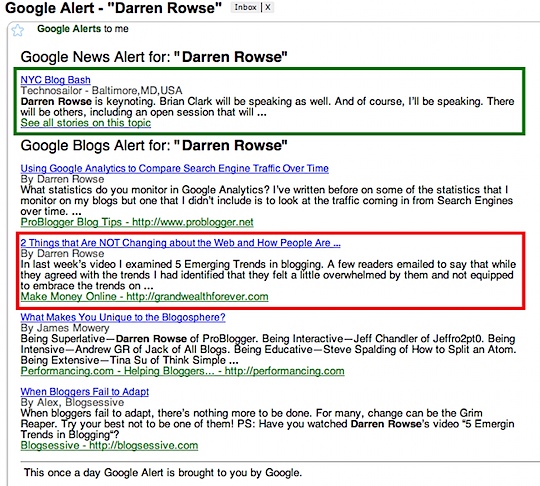
Just as I was writing this post an email hit my inbox with one of my News Alerts. I set up one for “Darren Rowse” and here’s what it sent me today (click to enlarge):
It’s great to get news results and blog results like this each day - however….
1. The first result (highlighted in green) is actually for a post written in May 2007
2. The second result (highlighted in red) is actually for a scraper site that picked up one of my own posts. What I find interesting is that Google News found the scraper site and ranked it and it didn’t find my own site’s version of that post. This is something I see every day in News Alerts - they attempt to cut out the duplicate content but in doing so seem to be promoting scraper versions instead of the original content.
3. Lastly I’m a little confused as to why they sent me an email with 5 search results for my name when their Blog Search Results for my name show 20 or so results in the last 24 hours.
Don’t get me wrong - Google News Alerts rock and are an important part of my own monitoring of keywords that are relevant to me - however they’re not perfect and I know they miss a lot and put up flunky results from time to time - I guess you get what you pay for.


Wednesday, March 4, 2009
How to Use the New, Tougher MySpace For Effective Network Marketing
There is no doubt that marketing on MySpace has become harder. That is not necessarily bad news, as it means that those who take the time and trouble to adjust to the new circumstances will have a far greater chance of success.
It is no longer possible to just blunder onto MySpace, make every mistake in the book, and then expect to make friends and profits. It was inevitable that as MySpace began to enjoy great success, the spammers and exploiters would try to use this to their advantage. It was equally inevitable that MySpace would react by passing tougher regulations to counter this.
Where this leaves us now is that MySpace marketing is still possible, but it needs to be done in a far more subtle way. Even the objectives have fundamentally changed. Instead of promoting products or services, the main task of modern MySpace marketing is self-promotion. By creating a profile which shows you off as being reliable, trustworthy, and knowledgeable about your subject, you can attract other members to you who can become customers or even business associates.
With the huge numbers of people using MySpace every day, most of whom are full mature adults, there is almost limitless potential to turn your time on the site into business leads. The vast majority of people on the site will be interested to some degree in any business opportunity which you can prove will change their lives for the better.
Many of these people will be of the same mentality as you. They will be looking to use the near-unlimited potential of the social networks to build up their own network of contacts. If you can recruit someone like this into your downline, you are obviously setting yourself up for a great deal of potential success.
As with any other form of marketing and promotion, you need to adjust to prevailing trends and keep abreast of the market. MySpace may have changed dramatically, but that does not mean that it is not still an extremely useful tool, which should form part of your marketing campaign. If your business deals with people, then MySpace should be a part of your overall strategy, for no other reason than the sheer numbers of potential leads you can reach.
Scott Geertsen Is An Expert Internet Marketer Who Teaches Other Network Marketers How To Use Cutting Edge Technology To Generate Huge Profits and Endless Leads In Their Business At: http://www.MySpaceSecretz.com
Order Book Here

Get Paid For Videos
Get Paid For Videos
Paid for videos is a new concept of making money on the internet. The idea of paying people for their videos was brought about by the multibillion dollar expansion of YouTube and the rising popularity of watching videos online. YouTube is a video sharing network that has been built up by internet users submitting their videos for free. This gave websites the idea to split the revenue from their videos with them to pull them away from YouTube.
Video sharing networks make all their money from the ads you see on the side. Instead of submitting your good videos to YouTube submit them to a network that will share the ad revenue from your videos with you. That is only fair. MetaCafe, a paid video sharing network, will probaly pass YouTube in the upcoming years in terms of popularity.
--------------------------------------------------------------------------------
Best Paid For Videos Platforms
MetaCafe is by far the best paid video program on the internet. MetaCafe has millions of people on their site viewing videos every minute of the day. When you upload a video to MetaCafe your video is likely to be viewed by a lot of people. MetaCafe pays $5 for every 1000 times your video is viewed. When you post a new video it is displayed on the MetaCafe home page. The videos I post usually get more than 700 views within the first 10 minutes of being uploaded. After that views slowdown or speed up depending on how good your video is.
Motion.tv is a good paid for videos website. Users get paid to submit videos by getting a share of the ad revenue their videos generate. They have fair pay. It is hard to get page views because they lack in traffic. You can make that up by submitting your videos to social networking sites. For a complete list of social networking sites go to social poster. The minimum payout is $20.
Find more videos like this on motion.tv
--------------------------------------------------------------------------------
More Paid For Videos PlatformsRevver
Revver is a decent video sharing network. They display targeted google ads next to videos. They split the money 50/50 with the publishers of videos. Revver is a professional looking website with a nice high tech look, but lacks in traffic. They have a user friendly affiliate program. You can embed their videos on your website if you have one. In that scenario the money is split three ways.
Si-Mi
You can sell your videos, podcasts, music, photos, and ebooks at So-Mi. You get 90% commission on everything you sell. Their platform encourages people to upload their digital products with a convienent easy to use platform and fair commissions.
ExpoTV
ExpoTV pays you $.01 each time your video is reviewed. That is equal to $10 per 1000 views. They give a $5 reward for submitting movie reviews plus ongoing royalties. You get a bonus for submitting a certain amount of videos per month.
luluTV
luluTV is a unusual video sharing network. You have to create a shareholder account. After that you get a portion of the revenue from the advertisements placed next to your videos.
mytvbiz
Mytvbiz allows user to upload any type of video. You set a price on your video for people to buy. You earn 70% commissions on every video you sale. The minimum payout is $15. They pay with Paypal.
OnlyStage6
OnlyStage6 is a video sharing network similiar to mytvbiz. You upload videos for sell. You set your own price and earn 90% on each sale. There is a small processing fee on each sale.
SuperIndieFilms
SuperIndieFilms is a platform for selling full movies opposed to making money off short clips. In order to sell a full movie on the website you need to create a movie trailer. You earn 90% commission on each movie you sell.
FlixYa
FlixYa is similiar to revver. You make money off targeted google ad being placed by your videos. You can also make money by referring friends to the website. If you don't have videos of your own you could upload some from YouTube as long as they are not copyrighted.
AtomFilms
AtomFilms encourages users to submit short original films, start your own webshow, or create a original cartoon. If you get approved you will sign a professional contract that states the royalties you recieve from each video.
Current
Current is one of the few sites where pods are popular. Pods are short videos or stories about whats currently going on in the world today. They pay a flat undisclosed rate on each submission. Current even has their own channel on DirecTV. You might be able to get a podcast on national television.
Blip
Blip is only looking for people interested in starting their own web show. If you are interested in starting your own web show do it somewhere else. There is not sufficient traffic on their site to get the most out of your time.
Break
Break is a paid for videos website that has paid over 1 million dollars to members. You can get paid up to $2000 if your video makes it to the frontpage. They will also pay you for pictures. They pay with Paypal.
--------------------------------------------------------------------------------
Tips To Increase Earnings
Start Your Own Web Show
Starting your own web show is a great idea if you are interested in making videos for money. Some people make a career out of this. People have even landed professional acting jobs for their performances on web shows.
Submit Your Video To All Paid For Videos Websites
The more websites you submit your video to the more money you are going to make. Upload your video on MetaCafe first. All platforms accept MetaCafe and YouTube inclusions. Don't use YouTube because they don't pay you anything.
Add Your Videos To Social Networks
Social networks recieve tremendous traffic and the potential to market your videos. MySpace is an example of a social network. Others include Digg, FaceBook, Twitter, and Propeller. This is another way to get paid for videos.
Sunday, February 15, 2009
10 Tips for Great Musicians
by John aka Jupiter King, Jun 25, 2008
The must-haves for any musician worth their salt.
Blues man Jack White is one of my favorite musicians, what got me hooked on Jack's music was when he did the song Portland, Oregon with Loretta Lynn. Another reason I like Jack White's music is because of the album Consolers of the Lonely. I was reading about Jack in Rolling Stone and it was then that I realized his talents are far reaching.
It is said that some just have the gift, and Jack evidently is one of those blessed with the talent it takes to make it in the harsh world of music. Music, as any seasoned musician will tell you, is like a relationship, you nurture it and it will grow.
Not to say that along the way there won't be pitfalls, but if you know what to look for and what not to do you can avoid those.
What's the Difference Between a "Good Song" and a Hit?
This question is key to any musician's bid for success in the music industry.
A "good song" might have all the right beats, it might have great musicianship, it might even be by a world-famous band, but what makes a "good" song into a Hit is how it touches the audience.
There are 10 must-haves for any musician:
1. Talent
2. An ear for other talent
3. Must work well with others
4. A distinct sound,(if you're "forcing it" the audience can tell.)
5. Authenticity (goes back to my point in the 4th must-have)
Before I go on to the next five must-have's keep in mind these are the observations of an author and that each person's ideas of music may be different.
6. A musician must have heart, I know I may have put that as the 6th point, but it is essential
7. A musician must be willing to diversify, repetition can become nauseating and redundant.
8. A musician that knows his/her audience will do far better than a self-absorbed musician
9. A clean nose (what I mean by this is, while the "bad" image may have sold in 1965, we have since learned that drugs kill, so stay away from them)
10. Most important must have for a musician is Soul, after all if your music is empty, then what's the point?
To All who read this, take it to Heart..


10 Essential Tips for Making a Living with Your Music
By: Christopher Knab (Click here to see his book)
Top 10 Lists are a favorite hobby of our society. It’s a fun way to keep up the illusion of the simplicity of things in a complex world. So...why not a Top Ten List on the subject of Making A Living From Your Music? The following list highlights 10 habits you should develop if you want to make a living some day, just from your music. Remember that there are a million ways to get to any intended destination. From my observations over the years, this list of professional habits are shared my most successful musicians who truly have what it takes to succeed in this totally unpredictable business of music.
1. Find ways to get ordinary people who love music, to love your music.
We live in a time when everybody and their sister can and does make their own music. That doesn’t mean however that your music has what it takes for record labels to invest their money and time developing, promoting, and marketing that music. Try your music out on music fans like you solicit opinions from A&R Rep. These talent scouts of the music business are always following tips they hear from their street connections. But remember, your music must truly stand out in some significant, original, dynamic, and creative way. 95% of the independently produced CDs out there contain regurgitated ideas that were ripped off from some other more gifted musicians. Prove to the industry that ordinary music fans in your city love your music. You can find this out by giving away samples of your music on the street, or outside a musc venue where an artist similar to your music style is playing. (Be sure to have your contact information on the CD or flashdrive or whatever your music is on.) Also, put songs on your website, your MySpace page, or any of the newer social networking sites. The fact is that If people love something they let other people know about it. So, you can find out quickly if your music has what it takes by bringing your music to the people.
2. Play live often and don’t worry (at first) about getting paid for every gig.
You can always tell the difference between a musician who is in it for the money, and a musician who is in it for the music. The dedicated musician can’t not play music every chance they get. Money-focused musicians whine about the fact that they can’t get club gigs that pay anything. If you really think that you can make your living solely as a musician in the first three to four years of your career, you are headed for a breakdown and disappointment. Think about it...almost every legendary, gifted musician who has made a mark on our culture has been a musician who struggled long and hard at their craft, and...never gave up. Eat determination for breakfast! Go out there and play on the streets if you have to, play at schools, fairs, festivals, do benefits to help other people and organizations. Offer your services to non- profits, charities, church groups, and any other companies or organizations you can think of. Hang out at clubs, look for jamming possibilities, or start your own jam sessions. Look around your city or town, and you will see many places and venues where musicians can play. As you establish yourself and more and more people show up at your shows, the paid gigs will increase. Remember... play live, and then after you play live, play live again, that’s what musicians are supposed to do.
3. Know your instrument inside-out.
One of the curious developments of the late 1970’s was the huge increase in garage bands, punk bands, rappers, and ‘do-it yourselfers’, who just picked up an instrument, or started to sing with some friends, and 6 months later recorded a record and began to play live. Some great music, and new directions in music, came out of that situation. But now, 30 odd years later, the novelty of hearing amateurish thrashings has gotten a bit dull.
Prior to late 70’s, more often than not, the music that is our heritage was made by musicians who, from the time they took up their instrument, worshipped at the feet of some master bluesman, jazz player, folk legend, songwriter, or whatever. The habit of these inspired musicians was an appetite for perfection. A need to be not just ‘good enough’, but GREAT. Why settle for less. Whatever developing stage you are at, go beyond it, re-commit yourself to your instrument or voice. Take lessons, or better yet, sit yourself down at your CD player and choose a favorite guitar player’s record, and listen closely to what they are playing. then re-play it, and re-play it again. Challenge yourself to go beyond your limitations. Who knows, maybe you will fall into some new territory, wherein you will find yourself, your ‘sound’, and increase your chance to stand out from all the mediocrity that is your competition. Believe it or not, record labels love to hear innovative, accessible new sounds. Actually in their heart of hearts, that is what they are really hoping to hear on every new demo they get, and from every new act they go see at a live venue. You see...in the business of music, when we hear something new, original, and accessible to people, we can then invest in you with more security, believing that if we put our ‘label brand’ on you, with our talents of promotion and marketing coming to the front, then we ‘have something’, and your music becomes our music, and we work together to broaden you audience appeal. It’s kinda like a partnership ...something about ‘Art and Commerce’...they can work together you know?!
4. Protect your investment...register your songs for proper copyright protection.
I never cease to be amazed how few artists are willing to spend a few bucks to register their songs with the Copyright office. By the way, these folks are often the same folks who complain about not getting paid to perform their unknown music. All I know is that when an inventor comes up with some new product that they think will appeal to a certain type of customer, the first thing they do is file for a patent on their invention. The same reaction to protecting songs should be there for any serious songwriter. If you really intend to work hard and develop your career as a musician who writes your own songs, don’t wait too long to take care of this simple, but essential task. If you really believe in your unique and original music then take the time to learn the basics of copyright protection. From the Internet to the library, there a number of easy ways to learn what it takes to file for copyright protection. Do it now! Go to www.copyright.gov and follow their links on Copyright registration information.
5. Design and write your promotional materials so they stand out.
The topic of designing and writing effective promotional materials; bios, fact sheets, cover letters, quote sheets etc. is a lengthy one to say the least. As far as some tips that can help musicians promote their careers, and contribute to their getting any deal offers, is to make the promo materials as compelling, and informative as possible. Take the time to inventory any accomplishments, positive reviews, training and awards, past sales, and live appearance highlights; and organize them into professional written bios etc. Having done that, time also needs to be taken to research who to send the materials to, and to ask each potential recipient what type of information they would like to have sent to them. No ‘generic’ kits should ever be sent out to any gatekeepers in the music business.
6. Know the labels and music publishers you hope to be signed to.
If you were applying for a job with a certain company of corporation, wouldn’t you take some time to ask questions about their stability as a business, their reputation in the industry, and the executives background and experience? The same is true when shopping for a record deal. Some musicians get so excited when a certain label approaches them with a recording contract, or a publishing company offers to sign them. Being approached for a deal is a compliment and recognition by a label or publisher that a musician’s music is attractive to them. But, to rush ahead without taking the time to learn a few things about them is foolish indeed. How have they done with your particular genre of music? What specific ‘points’ are they offering you? Who runs the label or publishing company? What is their reputation in the music business? How do you like them as people? These and other questions can be crucial in making an unemotional decision about an arrangement that could make or break your career.
7. Have your own ‘Entertainment Law Attorney’ to represent you.
The business of getting signed to any deal in the music business has always had, has now, and will always have, the involvement of entertainment law attorneys. No jokes will be inserted here, because any relationship between a musician, a record label, a publisher, a merchandiser etc. will come down to two attorneys hashing out the contract for the musician and the respective companies. It should be pointed out here that when all is said in done with the ‘courting’ process, the musician is never present during the actual negotiations. The musicians attorney and the music company’s attorney meet, talk over the phone, and fax their offers and counter-offers amongst themselves. This fact serves to remind you that choosing a reputable, ethical, well respected entertainment law attorney is an absolute necessity for any serious musician who wishes to fight the good fight in the legal arena.
8. Choose a well-connected and respected personal manager.
Self-management is always a valid option in the developing stages of establishing your career as a musician. Much can be learned by taking on the jobs of securing gigs, getting some publicity, planning tours, dealing with personal issues that arise within the band, and schmoozing with A&R Reps and various other label and publishing personnel. However, there comes a time, usually when the daily tasks of doing the business of being a band takes up too much time, and it is at this time that the services of a good manager can be very useful. I have always felt that if any musician or band has worked hard to establish their career, and achieved a modicum of success, they will have a better chance to ‘attract’ the services of a professional, well-connected and respected manager.
Managers who do this job for a living can only take on clients that generate income. Making money as a personal manager is no easy task, and many upcoming artists forget that if any moneys are to be generated from their music, it can takes years for the flow of that income to be reliably there. So, as a band develops self-management, or gets help from intern/student manager-wannabees, can help pave the road for professional management.
Over the years I have heard several horror stories about ‘managers’ that approach upcoming acts and say that for X amount of dollars, they can do such and such for the artist. No... this is not the way legit personal managers work. Well-connected and respected personal managers get paid a negotiated fee for their services (get it in writing) for any and all business transactions they are responsible for (15%-20%) over a particular contract period. Please Note...No musicians should ever pay a fee to a so-called ‘manager’ who will not do any work UNLESS they are paid up front. Flim-Flam men and women still abound in this business... be forewarned.
One of the most important jobs of a manager is to secure recording and publishing contracts for their clients, this is why it is so essential to choose well connected and well respected managers. The music business is a ‘relationship’ business. Who know who, and who can get to know who, and who did what successfully for who is what this management game is all about. Choose carefully those people who will be representing you in any business dealings.
9. Don’t take advice from anyone unless you know that they know what they are talking about.
At the beginning of this article I stated that there are a million ways to do something, and that these 10 tips were just my comments from years of dealing with the business itself and musicians. Everybody has their own list of Do’s and Don’ts and the only real value they have is that they present you with ‘opinions’ about what to do to get established as a musician.
To be quite candid, the best rules in the music business comes from the experience of building your own career; learning from your own interactions with the gatekeepers at labels, the media, management, and booking companies as to what is right or wrong for you. For every Do or Don’t there is an exception to a so-called ‘rule’. As I reflect on the advice I sought out and listened to over the years, the most valid tips came from people who walked the walk, and talked the talk. If you feel that the source you have contacted knows what they are talking about, and has had first hand experience doing what you want to learn about, that is the only feedback that might stand up over time. Choose carefully.
10. Musician...Educate Thyself! If you want a record deal, learn what a record deal is, and learn something about the business of music.
Naïve or mis-informed musicians are a menace to themselves. Enough already! Over the decades there have been countless stories of musicians who were ripped off by their record labels and music publishing companies. Why? Exploitation was the name of the game way back when, and regretfully it hasn't gone away. Keeping musicians in the dark can still be standard business practice for many sleave-balls who are in this busienss. However, you can't be a naive artist these days, so any any musician who signs a record contract (and learns later what he or she signed) have only themselves to blame. )
Today there are dozens of outstanding books available on every conceivable topic related to the business of music. They can be found in bookstores, libraries, and through the Internet. In addition, there are many schools that now offer 2- 4 year programs on the business of music. Seminars, and workshops are available on a year round basis in most major American cities. Consultants, Attorneys, and Business Organizations are all around and so it is only myth, superstition, stubbornness, and immaturity that stand in the way of any musician making a commitment to educating themselves about the business that exists to exploit their music.
I cannot stress how important I feel this issue is. Educating yourself is THE most important suggestion I can make to help you have a chance at success.
If you won't learn about the business side of this industry, do you really expect the professionals you encounter to sit down and teach you? Get Real!
Please...spend some time and money educating yourselves about the music business, . A few hours now, can protect your future forever!.



Saturday, February 14, 2009
Jimmy Iovine on Having a Successful Career in Music
Interscope Records head Jimmy Iovine shares some advice for new artists on how to stack the deck in your favor and help ensure a long and successful career.
Main Points
-A lot of ways to get your music out
-There is Good technology to help create your music
Don't get in a hurry and Learn your Craft
-Good Article by John aka Jupiter King
-Have a wide view of media (Be multifaceted)
Write Your Own Music - Be Critical Of Songs!
-Good Article by Christopher Knab
Be Unique
-Video By George GiBi del Barrio
-Video By Disc Makers' President, Tony van Veen
Jimmy Iovine- Advice for Being a Successful Artist
Interscope Records head Jimmy Iovine offers advice to aspiring artists on how to lay the groundwork for a long and successful career in the music industry of tomorrow.
Main Points
Get music recorded because it is easy to get to the public.
TEN WAYS TO GET YOUR SONGS RECORDED
by John Braheny
How To Record a Music Demo
Get Great Live Events and work hard on your live events
How To Take Advantage of a Gig - Turn Your Audience into Fans
By Heather McDonald
LIVE MUSIC BLOG.com
It is very easy to communicate with people about new music.
“Music fans and musicians belong to each other”
Soulja Boy had 4,000,000 kids watching his youtube video - That is why he got signed.
Don't move to fast and perfect your craft & Make very good music!
SO YOU WANNA GET SIGNED TO A RECORD LABEL?
Get website and make it good
Tips to creating your website.
Jimmy Iovine- Finding New Artists at Interscope Records
Interscope Records head Jimmy Iovine discusses how new artists come to the notice of the label, and what he personally looks for in the artists he signs.
Main Points
Record Labels look everywhere when trying to find new artist.
So you want a record deal?
Not hard to get a record deal but the Music must be really good or People must think your music is very good.
Music needs to be original and unique and he spirit in music must be there.
To Be Successful In Music Marketing On Any Level Is To Define Your Musical Niche
One model does not apply to every situation - Must adapt the deal to the specific situations.
Jimmy Iovine- Competing with Free
Interscope Records head Jimmy Iovine shares his opinions on what record companies need to do to survive and make money in today's music industry -- if music is free, how do you make your service good enough for people to pay for it again?
Main Points
This is basically talking abot what needs to be done for the record labels to catch up with whats going in the music industry. You must have unique content! Unique content is a must! Get the music - Mary it with technology and make the service incredible. Now there are services that are doing this. Services such as ilike.com have taken the service of music to a whole new level. This was Jimmy Iovine's main point in what record companies need to do to evolve with the future of the music industry. It is also what each band, artist and musician needs to do for themselves. It goes back to running a band like a business. Bands have to realize that starting a band or a group is just like starting a business. And just like a business, you have to be unique to bring customers into your doors. If you want to take your music to the next level - you need to first record your music, use technology (online and offline) to promote your music to the masses and then you need to service your customer to the fullest extent. Give them what they, talk to them, give them live shows via the Internet, ect...
Jimmy Iovine- Are Record Companies Really Evil?
nterscope Records head Jimmy Iovine sheds some light on why record companies are the first to be blamed when things go wrong for an artist, and why they only sometimes deserve it.
Jimmy Iovine- What Makes a Great Record Producer
Interscope Records head Jimmy Iovine shares his thoughts on what the great producers have that the rest of us don't.
Subscribe to:
Posts (Atom)


About Me

Join These Communities
 |  |
 |  |
 |  |
 |  |
 |
 |
 |
 |
 |
 |
 |
 |
MEDU NETR

Erge Entertainment

Copyright © 2009 Fresh Themes Gallery | NdyTeeN. All Rights Reserved. Powered by Blogger and Distributed by Blogtemplate4u .